
What Are Compound Interests and How Do They Work?
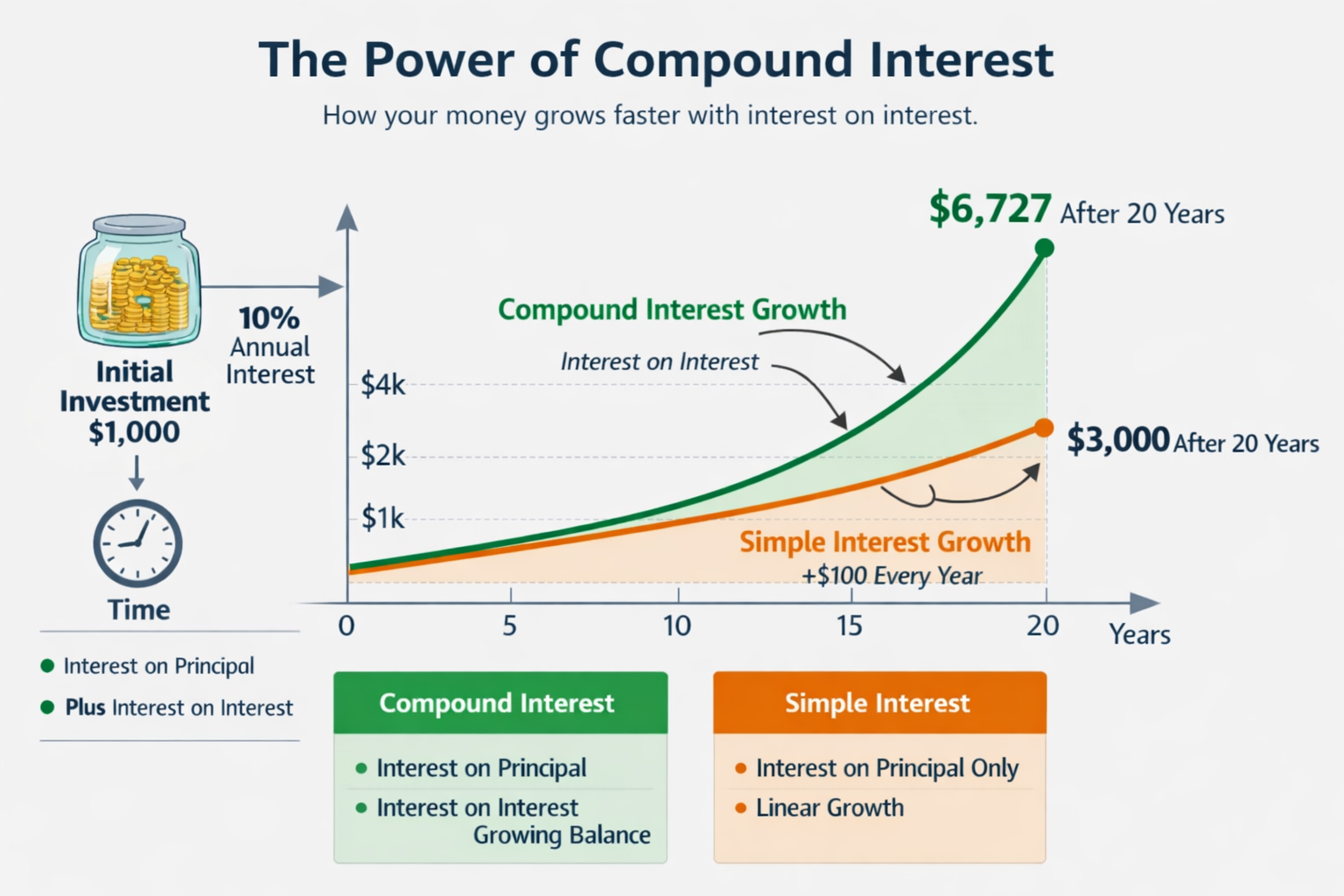
Compound interest is one of the most powerful concepts in finance. It refers to the process where interest is calculated not only on the original amount of money invested or borrowed (the principal), but also on the accumulated interest from previous periods. In simple terms, it is “interest on interest.”
Unlike simple interest — which is calculated only on the principal — compound interest allows money to grow at an accelerating rate over time. This compounding effect is what makes long-term investing so powerful.
How Compound Interest Works
To understand compound interest, imagine you invest $1,000 at an annual interest rate of 10%.
- After the first year, you earn $100 in interest (10% of $1,000).
Your total becomes $1,100. - In the second year, you earn 10% not on $1,000 — but on $1,100.
That means you earn $110. - Now your total becomes $1,210.
In the third year, interest is calculated on $1,210, and so on.
Each year, the base amount grows larger, which means the interest earned also increases. This creates a snowball effect. Over time, growth becomes exponential rather than linear.
The Role of Time
Time is the most important factor in compound interest.
The longer your money compounds, the greater the effect. In the early years, growth may appear slow. But as interest accumulates, the growth curve becomes steeper. This is why starting to save or invest early can make a dramatic difference.
For example, investing smaller amounts over a longer period can sometimes produce better results than investing larger amounts for a short period. Compound interest rewards patience and consistency.
Compounding Frequency
Interest can compound at different intervals:
- Annually (once per year)
- Semi-annually (twice per year)
- Quarterly
- Monthly
- Daily
The more frequently interest compounds, the greater the total return will be — assuming the same interest rate.
For example, 10% interest compounded monthly will produce slightly more than 10% compounded annually because interest is being added to the balance more often.
Compound Interest in Saving vs Borrowing
Compound interest works both ways.
When you invest or save money, compound interest works in your favor, helping your money grow faster over time.
However, when you borrow money — such as through credit cards or loans — compound interest works against you. Interest on debt can accumulate quickly if balances are not paid off, leading to higher total repayment amounts.
Understanding how compounding works helps you make better financial decisions, whether you are building wealth or managing debt.
Why It Matters
Compound interest is often described as one of the most powerful forces in finance because of its ability to turn consistent contributions into substantial growth over time.
By reinvesting earnings and allowing interest to accumulate, individuals can steadily build wealth without needing constant large investments.
The key principles are simple:
- Start early
- Stay consistent
- Allow time to do the work
Even modest returns can produce significant long-term results when compounding is allowed to operate uninterrupted.